June 8, 2026 · 4 min read
The currency markets, specifically AUDUSD and NZDUSD, are showing clear signs of structural weakness, but patience is currently the primary requirement. While the primary trend is bearish, the price action is currently in a complex structure, presenting a high-probability "Smart Money" setup. Our current analysis identifies a potential "Judas Swing"—a false manipulation move against the overall trend—that could provide the optimal entry criteria for a heavy downside continuation.
Here is a step-by-step breakdown of how we are visualizing this specific setup and the conceptual confirmations we are tracking.
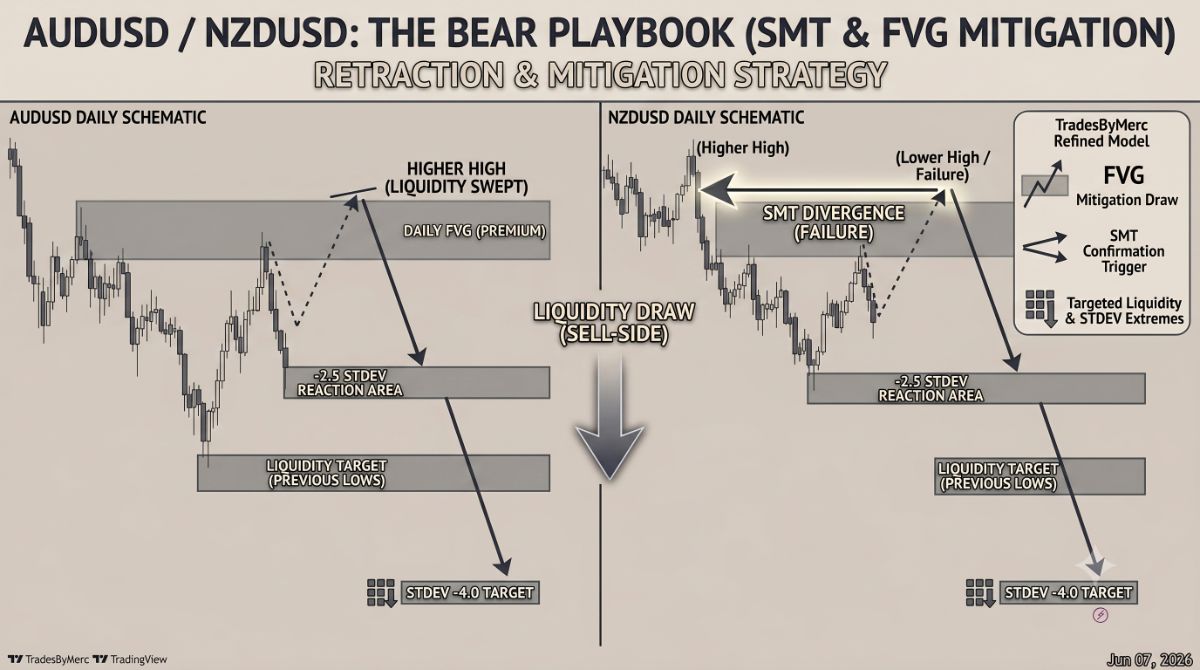
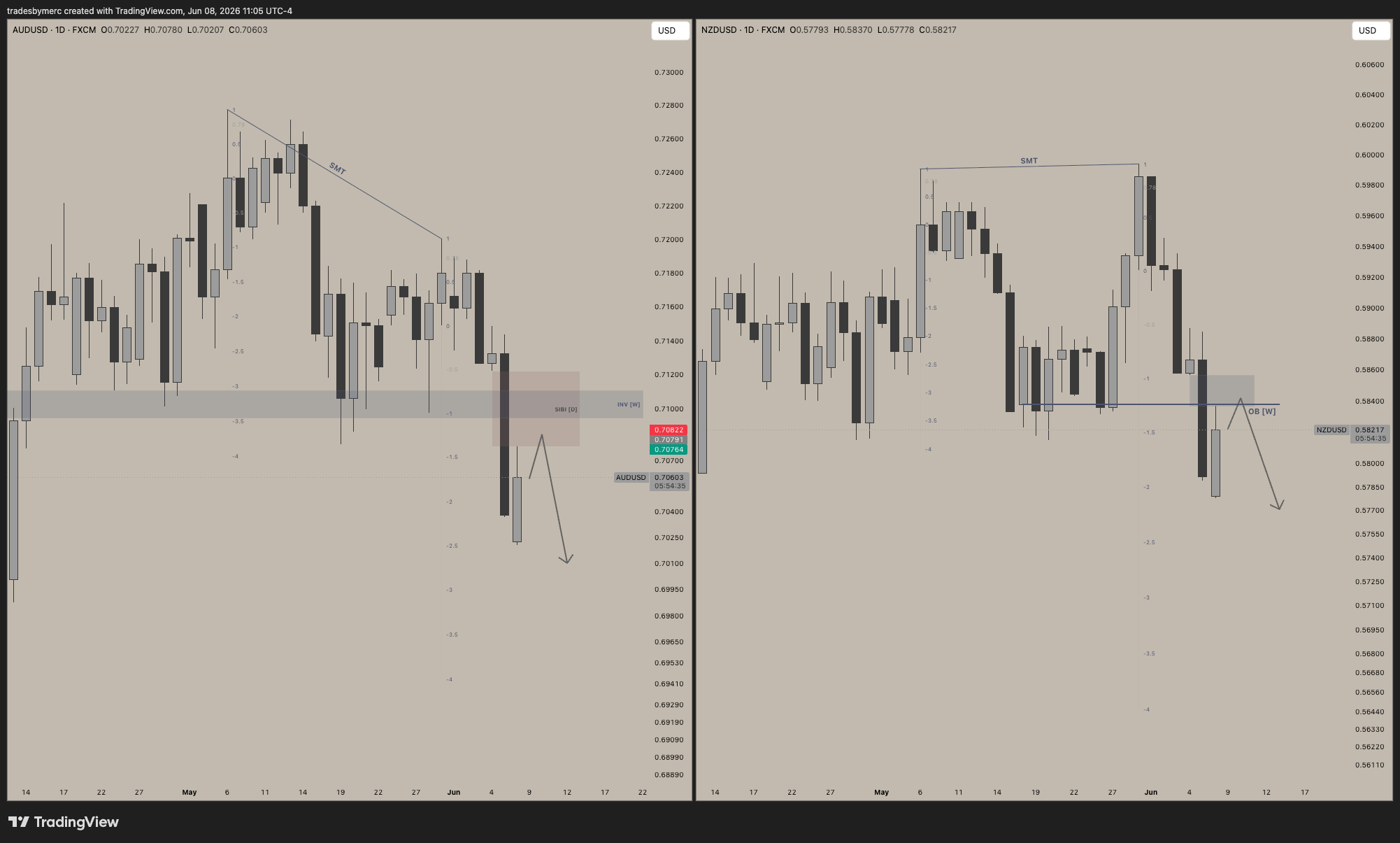
Both AUDUSD and NZDUSD have completed aggressive down-closing moves from their respective swing highs. This displacement has broken internal market structure. To measure the depth of the subsequent retracements, we have anchored Standard Deviation (STDEV) projections to the initial impulse leg.
Price is currently reacting around the STDEV -2.0 to -2.5 zone. This is a common level for market participants to begin taking partial profits, leading to the current corrective retracement or reversal behavior. While the move down is impulsive, we must respect these natural liquidity zones and allow price to complete its current "corrective phase" before looking for continuation.
This is the key component of our technical logic. As price retraces higher from the current STDEV reactions, we are looking for price to reach into the clear Daily Fair Value Gap (FVG) left behind on both charts during the initial impulsive leg.
Hypothesis: Smart money will drive price higher to mitigate the imbalance in that FVG, seeking to re-balance the market and trigger the remaining sell-side orders (which are at premium pricing) before reversing lower.
This FVG is the magnet that gives us confidence that the current up-move is a retracement, not a trend reversal. We are not looking to trade this Judas swing higher; we are looking to use it as our high-probability premium entry criterion.
As price trades into and mitigates the Daily FVG on one or both pairs, we must wait for the final high-probability trigger: the creation of a new SMT Divergence.
Setup: While price is at its highest point during the retracement and inside the premium array, we will compare the swing highs. A high-probability setup occurs when one pair makes a higher-high (sweeping liquidity), while the other fails and makes a lower-high. This is the ultimate signal of an algorithmic failure and that smart money is finished accumulating short positions.
Once the FVG is mitigated and the SMT divergence is printed, our thesis for bearish continuation is confirmed. At this point, the market has no further premium draw on liquidity. The remaining targets are clearly defined below.
Primary Targets: We will be targeting the major recent swing lows that formed the base of the current trading range (e.g., the June 10th or early May lows). This represents the deep pools of sell-side liquidity that algorithms are ultimately seeking to deliver price into.
Targeting Extensions: Further confirmation of bearish momentum will come if price accelerates toward the STDEV -3.5 to -4.0 zones, which now act as precise technical targets for the entire projected move.
We are in the critical phase of stalking the setup. It is essential to let the retracement play out. Avoid chasing the move higher. Wait for the mitigation of the Daily FVG, confirm the algorithmic "crack in correlation" via the SMT divergence, and then execute our precision entry with targets clearly defined by key liquidity pools and the deeper STDEV projections. Risk management should remain paramount with stop placements above the confirmed premium arrays once the setup is validated.
Disclaimer: This post is for educational purposes only and does not constitute financial advice. Always manage your risk.
NQ and ES May 25 - 29, 2026 Outlook
May 24, 2026 · 1 min read
Stalking the Judas Swing in Aussie & Kiwi – The Bearish Path
Jun 8, 2026